Introduction
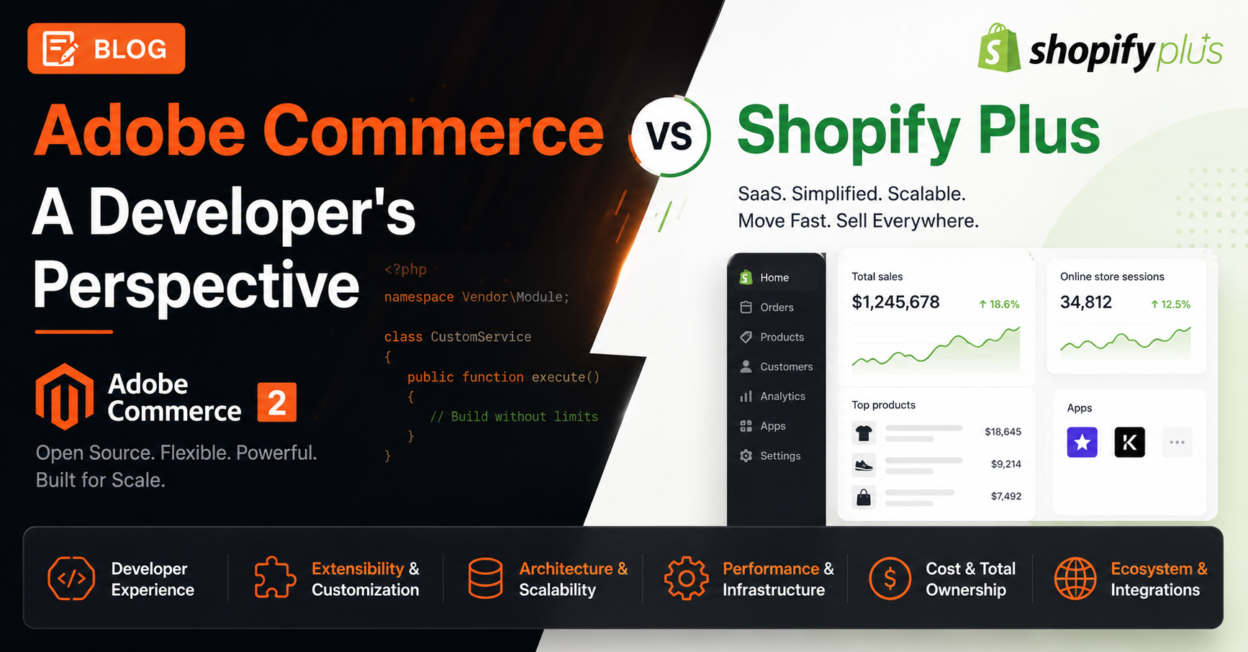
“Adobe Commerce vs Shopify Plus” is one of the most searched enterprise ecommerce comparisons — but most of the content out there is written for CMOs and procurement teams, not the engineers who’ll actually be living inside the platform. This post takes a developer’s-eye view: architecture, extensibility, APIs, theming, and the day-to-day tradeoffs that don’t show up on a feature checklist.
1. Architecture and Deployment Model
The biggest structural difference between the two platforms is who owns the runtime.
Shopify Plus is fully hosted SaaS. Shopify manages infrastructure, scaling, patching, and uptime — your team never touches a server.
Adobe Commerce now ships in three distinct shapes, and which one you’re evaluating changes the whole comparison: on-premises, Cloud (PaaS), and Adobe Commerce as a Cloud Service (ACCS). ACCS is a newer, versionless SaaS product built around a single GraphQL endpoint per tenant, with extensibility that happens exclusively out-of-process — through App Builder, API Mesh, Events, Webhooks, and the Admin UI SDK — rather than in-process code changes.
On traditional PaaS/on-prem Adobe Commerce, your team is responsible for hosting, caching layers (Varnish, Redis), indexing, and DevOps capacity — the tradeoff for full backend control.
Developer takeaway: If you’re evaluating “Adobe Commerce,” clarify which Adobe Commerce. PaaS/on-prem gives you a traditional PHP monolith you fully control; ACCS behaves architecturally much closer to Shopify.
2. Extensibility and Customization Model
This is where the two platforms diverge the most philosophically.
Shopify Plus extends primarily through its App ecosystem and code-level tools like Shopify Functions — serverless, sandboxed customization points for pricing, shipping, and checkout logic — plus Shopify Flow for workflow automation and ERP integrations. Customization happens within Shopify’s guardrails: you extend defined extension points rather than modifying core behavior.
Adobe Commerce (PaaS/on-prem) uses a traditional in-process extension model: PHP modules, plugins (interceptors), and full dependency injection overrides. Nothing is technically off-limits — you can rewrite core checkout logic, the catalog engine, or the admin itself.
Adobe Commerce (ACCS) flips this model. Since core application code is locked down on ACCS, in-process PHP customization isn’t possible — extensions have to be rebuilt as out-of-process App Builder apps instead. This is a meaningful migration consideration: many popular Magento marketplace extensions are being rewritten as App Builder apps, and teams evaluating a PaaS-to-ACCS move should plan an extension audit early, since a real share of existing extensions won’t migrate one-to-one without redesign.
Developer takeaway: Shopify’s model is faster to build within but has a hard ceiling. Adobe Commerce PaaS has effectively no ceiling but demands more PHP/Magento expertise. ACCS sits in between — API-first and event-driven, but with a real extension-rewrite cost for anyone migrating off PaaS.
3. APIs and Headless Commerce
Both platforms are API-first at this point, and both support fully headless architectures.
- Shopify offers the Storefront API and the Hydrogen framework (React-based), deployed on Shopify’s Oxygen hosting — a fairly opinionated but polished headless path.
- Adobe Commerce exposes REST and GraphQL APIs, plus API Mesh, a service that lets you combine REST, GraphQL, SOAP, and JSON sources from multiple vendors into a single unified GraphQL endpoint without modifying the underlying systems. Adobe’s original headless framework, PWA Studio, still exists, but adoption has slowed in favor of custom Next.js or Vue builds on top of the GraphQL layer.
Both platforms’ REST and GraphQL APIs are generally considered solid, though Adobe’s API surface is often viewed as better suited to deep ERP and legacy-system integration, while Shopify’s documentation is especially strong for common patterns like order management and inventory sync.
Developer takeaway: If you want a batteries-included, well-documented headless stack, Hydrogen/Oxygen is the faster path. If you need to federate multiple backend systems — ERP, PIM, OMS, legacy services — behind one GraphQL contract, Adobe’s API Mesh is purpose-built for that.
4. Frontend and Theming
- Shopify uses Liquid templating for traditional themes, or a fully decoupled Hydrogen storefront for headless setups. Either way, Shopify controls hosting and CDN delivery of the storefront.
- Adobe Commerce ships with a native Luma theme (a server-rendered PHP/Knockout.js frontend) or can go fully headless. In practice, many agencies now build on Hyvä, a lightweight Tailwind/Alpine.js frontend that replaced the legacy theme stack for a lot of new builds. The Hyvä theme core became free and open source in late 2025, and it’s become a common performance-focused choice for PaaS/on-prem projects.
Developer takeaway: Shopify’s frontend story is more unified; Adobe Commerce’s is more fragmented but more flexible — you can pick Luma, Hyvä, PWA Studio, or a fully custom headless frontend depending on your performance targets and team skill set.
5. B2B Capabilities
Both platforms have converged significantly here over the past year.
As of April 2026, Shopify extended foundational B2B features — company profiles, up to three custom catalogs, payment terms like Net 30 and Net 60, volume discounts, and quantity rules — to all paid plans, with Shopify Plus adding unlimited catalogs, partial payments, deposits, and direct catalog-to-location assignment on top.
Adobe Commerce still tends to lead for the most complex scenarios: native tools for customer-specific pricing, company accounts, requisition lists, and multi-tier approval workflows, along with more native flexibility for complex inventory rules across sales channels and business units.
Developer takeaway: For straightforward B2B — tiered pricing, company accounts, quoting — Shopify Plus is now genuinely competitive and faster to implement. For deep, multi-tier approval chains, complex EAV-driven catalogs, or heavy ERP-bound pricing logic, Adobe Commerce’s B2B Suite still has more native depth.
6. Maintenance, Upgrades, and Security
This is arguably the most consequential difference for a developer who’ll own the platform long-term.
Shopify Plus has no upgrade treadmill — Shopify ships changes continuously, and merchants are always on the current version.
Adobe Commerce PaaS/on-prem does have one. Adobe publishes its own support lifecycle for each version — for example, at time of writing, 2.4.8 carries regular support into 2028, 2.4.7 into 2027, and 2.4.6’s regular support window closes in August 2026. For PaaS and on-prem merchants, that lifecycle table becomes a recurring engineering project: patch windows, extension compatibility testing, and occasionally breaking upgrades. Security patching, PCI compliance, and server configuration are also the merchant’s responsibility on self-hosted deployments, whereas Shopify manages that entire layer for you.
Developer takeaway: If your team doesn’t want to own a patch/upgrade cadence indefinitely, that’s a real point in Shopify Plus’s (or Adobe’s ACCS) favor. If you want full control over when and how upgrades happen, PaaS/on-prem Adobe Commerce gives you that — at the cost of owning it.
7. Performance and Scale
Both platforms scale to enterprise-level traffic, but they handle scale differently.
Adobe Commerce is generally regarded as stronger for very large, complex catalogs — multi-million SKU counts, deep configurable products, and heavy B2B pricing logic are areas where Magento’s EAV-based catalog model has historically had an edge. Shopify Plus, by contrast, benefits from a fully managed, globally distributed runtime that removes most performance-tuning work from the merchant’s plate entirely — caching, CDN, and checkout performance are all handled by Shopify itself.
Developer takeaway: If catalog complexity is your bottleneck, Adobe Commerce’s data model tends to flex further. If your bottleneck is traffic spikes and infrastructure reliability, Shopify’s managed runtime removes that concern almost entirely.
8. Total Cost of Ownership (a brief, honest note)
TCO estimates vary widely across agencies and vendors, and most published numbers come from parties with a platform preference — so treat any specific percentage skeptically. That said, the general pattern that shows up across multiple independent sources is fairly consistent: Adobe Commerce PaaS/on-prem tends to carry meaningfully higher ongoing costs than Shopify Plus once you factor in hosting, security patching, DevOps, and custom development time, while Adobe Commerce can still come out ahead at very high GMV in specific licensing brackets. The most reliable way to evaluate this for your own project is to model actual engineering hours — hosting, patching, upgrades, custom dev — rather than lean on a single vendor’s TCO claim.
Decision Framework for Developers
| Choose Shopify Plus if… | Choose Adobe Commerce if… |
|---|---|
| You want a managed runtime with no patch/upgrade burden | You need full backend control, including checkout logic |
| Your B2B needs fit Shopify’s native company/catalog/pricing model | You have complex multi-tier approval chains or bespoke EAV catalogs |
| You want a fast, well-documented headless path (Hydrogen/Oxygen) | You need to federate multiple backend systems behind one API (API Mesh) |
| Your team is smaller or less PHP-specialized | You have (or plan to build) in-house Magento/PHP expertise |
| You’re comfortable with SaaS-style tradeoffs anyway | You need on-premise or sovereign-cloud hosting |
Conclusion
The Adobe Commerce vs Shopify Plus debate isn’t really about which platform is more capable anymore — both are mature, enterprise-grade systems. From a developer’s chair, it comes down to a different question: do you want to own the infrastructure and extension model in exchange for near-unlimited control (Adobe Commerce, especially PaaS/on-prem), or do you want a managed runtime with a bounded but fast-moving extension surface (Shopify Plus, and increasingly Adobe’s own ACCS)? Model your team’s actual DevOps capacity and catalog/B2B complexity before deciding — that’s a more reliable signal than any generic feature comparison.